A Rug, a Lamp or a Side Table: Which Piece Earns Its Place?
Choose what to keep in a small seating area by matching a rug, lamp, or side table to a daily need, without adding clutter or blocking movement.
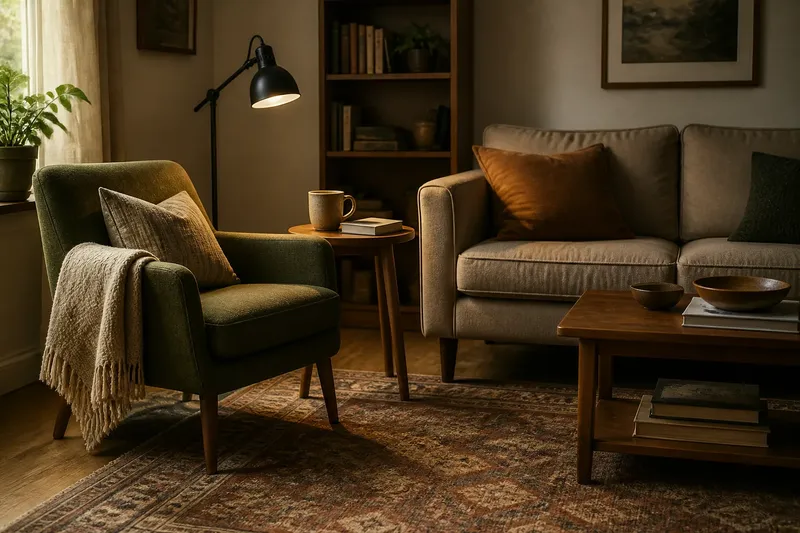
A mug balanced on the sofa arm, a book left open in a dim corner, and a rug that bunches underfoot can make a small seating area feel crowded for different reasons. To choose a rug, lamp, or side table, start with the task that is going unmet—not with the object that looks most decorative.
Notice daily friction
Spend an ordinary evening in the room and note where you pause, reach, or improvise. Is there nowhere steady to set a drink? Do you move toward the window to read? Does the seating feel visually unconnected, even though the chairs and sofa are close together?
These are different problems, and each points toward a different object. A side table offers a landing surface; a lamp brings light to a specific activity; a rug can give the seating group a shared visual and tactile base. First, name the problem plainly.
Write down one main job and, if needed, one secondary job. “A place for a glass beside the chair” is more actionable than “the room needs something.” If several frustrations compete, consider which one recurs most often and which object could address it without creating a new obstacle.
Test the side table
Consider a side table when something you use needs a stable home within easy reach. Beside an armchair, it might hold a reading lamp, a book, or a cup; beside a sofa, it may serve someone at one end while leaving the center seat free.
Before keeping it in the seating area, look at its shape and position. A small round table can be easier to approach around a chair than a boxy piece with sharp corners, while a narrow table may fit beside an arm without crowding it. The relevant question is not whether the table is compact in isolation, but whether it leaves room for the person seated there to move naturally.
Try the existing table at the spot where its job would happen. Sit down, reach for the surface, and then stand up without shifting the furniture. If the table is useful only after you lean awkwardly or keep moving it aside, it may be serving the wrong seat. A shallow tray on a nearby shelf or a clear sofa arm may be a better arrangement if neither creates an inconvenient reach.
Keep a side table when it supports a repeated habit and can remain in a workable position. If it mainly collects objects that belong elsewhere, clear it and observe whether its surface is still needed. A table does not earn space simply because it is convenient storage for things without a home.
Read the lamp by task
A lamp earns its place when its light makes a particular activity easier. A floor lamp near a reading chair, for instance, can direct light toward a page while leaving the rest of the seating area calmer. A table lamp may suit a side table already used for reading or conversation.
Notice where the light falls, not just how the lamp looks when switched on. A shade that sends most of its light upward may soften the room but do little for a book. A directional reading lamp may be more useful for close work, while a diffused shade can make a corner feel less stark. The bulb’s color and brightness also affect the result; follow the bulb and lamp maker’s guidance for compatible fittings and use.
Say you already own a floor lamp and an armchair, but the chair sits in a dim corner. Move the lamp beside the chair, angle its head toward the page, and sit down at the usual reading time. If the page is easier to see without glare in your eyes, the lamp serves a distinct job; if it lights an empty patch of wall instead, adjust its position or keep it elsewhere.
It is not worth rearranging an entire room to make a decorative lamp seem essential. Check the outlet location and cord path before settling on a position, and avoid placing the cord where it becomes a trip hazard. If the lamp cannot serve a useful activity safely, a different corner may be its better home.
Judge the rug by reach
A rug can make a seating group feel like one area rather than separate pieces scattered across the floor. It also changes how the floor feels underfoot. But in a small room, a rug that is too small or awkwardly placed can make the furniture look disconnected and become something people have to step around.
Use the furniture you already have as a guide. Look at where the sofa and chairs meet the floor, then consider whether the rug can sit under the front portions of the seating without obstructing a doorway or folding at an edge. If the rug lies only beneath a coffee table, it may still define the center, but it may not visually connect the chairs and sofa.
Check the rug in ordinary use. Walk across it, pull out a chair if there is one, and see whether its corners curl or its surface shifts. A rug pad may help keep a compatible rug in place, but check the floor and rug care instructions before choosing one. If the rug creates a recurring snag or blocks a needed route, its texture and pattern are not enough reason to keep it in this area.
Keep the rug when it helps the seating feel gathered or offers a welcome surface underfoot without disrupting movement. If it is too small for the arrangement, try moving it to a more suitable spot rather than buying a larger one immediately. A rug can be useful elsewhere in the home even when it does not serve this particular group.
Compare the three roles
Once you have considered each object on its own, compare the need it answers with the room’s actual use. A side table may be the clearest choice if a seated person has nowhere to put a drink. A lamp may matter more if the chair is used for reading after daylight fades. A rug may be the strongest keeper if the furniture feels unanchored and the floor is comfortable to cross.
One object can sometimes do two jobs, but that does not mean every piece must multitask. A side table can hold a lamp and a book, yet a crowded surface may make both less convenient. A rug can visually group furniture and soften a hard floor, but it cannot provide task light or a stable landing place.
- Side table: Check whether a seated person repeatedly needs a stable surface nearby. If the reach is easy and the table leaves room to stand, keep it there; if it crowds the seat, try a tray on a nearby shelf or move the table elsewhere.
- Lamp: Check whether its light reaches a regular task without shining into the reader’s eyes. If the page is clear and the cord stays out of the route, keep it near the seat; if not, adjust the lamp or relocate it.
- Rug: Check whether the rug connects the seating and stays flat during ordinary walking. If it does both without obstructing a doorway, keep it; if it shifts, curls, or blocks passage, reposition it or use it in another room.
- Clear floor: Check whether people can pass between the seating and the doorway without detouring. If the route is open, preserve that space; if an object narrows it, move the object before adding anything else.
- Shared surfaces: Check whether the table holds items used at the seat or mainly gathers things that belong elsewhere. If it serves a recurring activity, keep the useful items there; if it is a catchall, clear it and reconsider whether the table is needed.
- Overlapping jobs: Check whether two objects solve the same problem in the same spot. If each supports a separate habit without crowding, keep both; if they compete for space, use one at a time and relocate the one that makes movement or use less comfortable.
Say a reader has an armchair beside a sofa, a floor lamp in a dim corner, and a small rug beneath the coffee table. The chair is used for evening reading, but there is nowhere to set a mug; the rug stays flat, while the lamp lights the wall instead of the page. Move the lamp beside the chair, angle it toward the book, and check that its cord stays clear of the walking route; the page is now easier to see, so the lamp has a clear job. Place the existing side table within reach and sit down with the mug; if it can stay there without obstructing the chair, it earns its place too. The rug remains only if it still connects the seating without blocking passage; otherwise, move it to a more suitable spot. These are invented details, not a record of an actual room or test.
If none of the three answers a real need in this seating area, that is a valid result. They may belong in another room, or one can be stored until the arrangement changes. Keeping an object is not the same as insisting it remain in its current location.
Make one change at a time
Move the strongest candidate into position and live with that arrangement through the activities the area is meant to support. Avoid shifting all three objects at once: when several things change together, it becomes harder to tell which one improved the room and which one merely occupied space.
After ordinary use, ask a concrete question. Did you reach for the table without thinking? Did the lamp help you read comfortably? Did the rug stay flat and make the chairs feel connected? These observations are more useful than asking whether the room looks finished.
If the first object works, leave it in place and consider the next unmet job. If it does not, return it to its previous location and try another candidate. This is a way to make a decision with the furniture and accessories already on hand, not a reason to start shopping for a replacement.
Questions about keeping pieces?
Can a small seating area work without a rug?
Yes. If the chairs and sofa feel related without one, and the floor is comfortable and easy to use, a rug may not add enough to justify its footprint. An unobstructed floor can also make a compact arrangement simpler to move through.
Should a side table match the seating?
It does not need to be from the same set. Focus on whether its height and shape work beside the seat, and whether its material and finish feel at home with the other furniture.
Where should a reading lamp go?
Place it near the seat where reading happens, with light directed toward the page rather than into the reader’s eyes. Check the cord route and make sure the lamp does not interfere with standing or passing through the area.
What if two pieces seem equally useful?
Keep both temporarily if they serve separate, recurring tasks and fit without crowding the room. If they compete for the same space, try each on its own and notice which one gets used more naturally.
Keep the useful choice
The best keeper is the object that quietly supports the way the seating area is used: a surface within reach, light where a task happens, or a rug that makes the group feel settled. Revisit the choice when your routine changes, but do not treat an empty patch of floor as a problem that needs filling. In a small room, leaving space around the useful pieces is part of making them work.